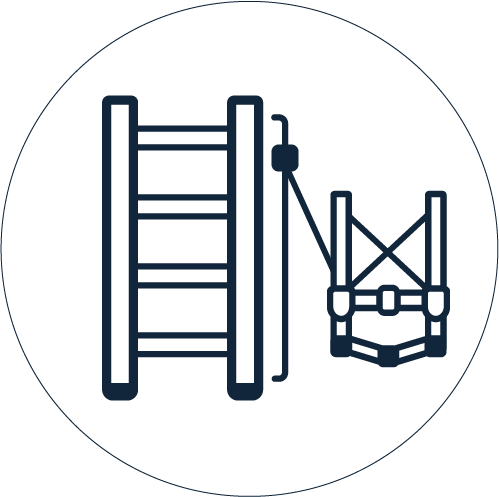
Stalen dek
Horizontaal railsysteem

Horizontale continue beweging

Grote horizontale verplaatsing, ophanging en/of trekwerk mogelijk
Het ALTIRAIL-klimbeveiligingssysteem is een onbuigzaam valbeveiligingssysteem.
In tegenstelling tot een kabellijn is het ALTIRAIL valbeveiligingssysteem zelfs effectief bij lage valhoogtes.
Het biedt een grote vloeiendheid en echt gebruiksgemak en kan op afstand, onder spanning of zelfs hangend worden gebruikt. Ongeacht de configuratie van uw dak of het type dakbedekking dat u hebt, de ALTIRAIL vangrail is modulair en kan worden aangepast aan alle structuren: beton, staal, waterdichte beplating, metalen of houten frames, enz.
Voor speciale toepassingen waar geen ondersteuning beschikbaar is, kan het ALTIRAIL systeem ook worden gecombineerd met een kabel.

De Altirail voldoet aan de volgende normen
![]() |
Persoonlijke valbeveiliging - Type D verwijst naar starre systemen, meestal railsystemen. |
![]() |

Speciaal ontworpen om op afstand, onder spanning of onder belasting te werken

Soepele bewegingen zonder haperen

Verkeer in meerdere richtingen dankzij de buiging van de rail en de punten

Efficiënt systeem, zelfs bij lage valhoogtes

Zorgvuldig ontwerp en afwerking voor een perfecte integratie met uw architecturale beperkingen

Stalen dek

Beton

Standaard berichten (ref : PST)
Neem voor meer informatie over deze oplossing tegen vallen contact op met onze experts
When it comes to selecting a horizontal lifeline system, there are a multitude of factors to consider. It's a decision that requires careful evaluation, given the critical role these systems play in fall-arrest and fall-protection. Delta Plus has a broad range of solutions, so you can be confident in finding the one that perfectly matches your requirements.
Firstly, it's essential to consider the nature of your work environment. Different work environments require different systems. For instance, working on a flat roof with a solid structure might warrant a different solution compared to a scenario where a worker is required to navigate around a curved surface or an environment with multiple elevation levels.
The type of work performed and the frequency of movement in the horizontal plane also play a critical role. If the tasks necessitate a significant amount of horizontal mobility, a system that allows for smooth and unimpeded travel would be a preferable choice. This could include self-retracting lifelines that automatically adjust to the user's movement.
Materials also matter. While most lifelines are made from high-strength steel cable, there are situations where a synthetic lifeline could be a better choice. These could be scenarios where the lifeline could come into contact with sharp edges that might potentially damage a steel cable, or in corrosive environments that could degrade metallic components.
It's also crucial to consider the number of workers the system needs to accommodate. Some horizontal lifeline systems are designed for single-user applications, while others can handle multiple workers simultaneously.
Always bear in mind that any system should meet the necessary OSHA regulations and ANSI standards. Each component of the system, whether it's the harnesses, lanyards, connectors, or the lifeline itself, should meet the required safety standards.
The chosen system must be able to limit the fall arrest forces to safe levels. In this context, the shock-absorbing capabilities of lanyards or SRLs play a critical role.
Lastly, the system should be user-friendly and comfortable for the worker. A comfortable harness and a smooth-gliding connector can significantly improve the user experience, potentially increasing worker compliance with safety regulations.